
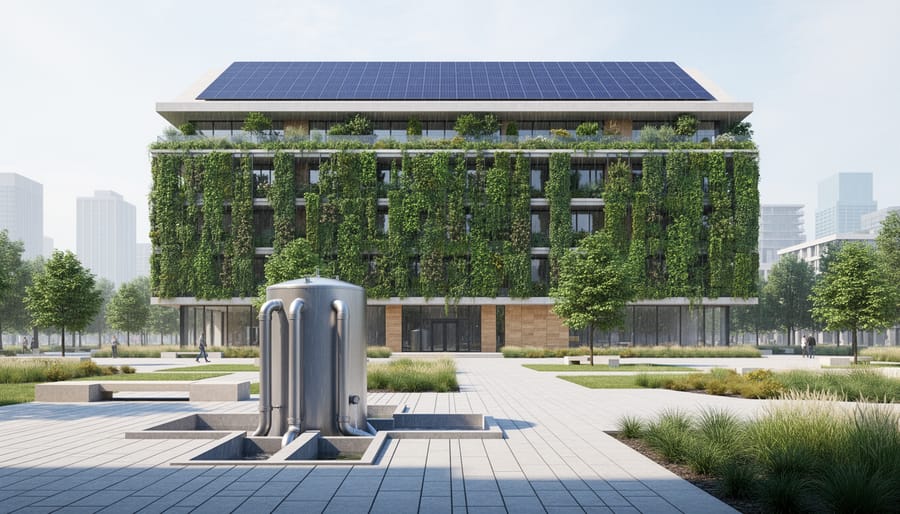
The race to net zero has produced architectural marvels that prove sustainability isn’t just an ideal but a measurable reality. Buildings across the globe are now generating more energy than they consume, purifying rainwater to drinking standards, and sequestering carbon in their very structure. These projects have moved beyond LEED Platinum certifications to achieve what once seemed impossible: structures that actively heal the environment around them.
What distinguishes the world’s most sustainable building from merely “green” construction? The answer lies in quantifiable performance data. The leading contenders measure their success through net-positive energy generation, zero waste to landfill, carbon negativity, and closed-loop water systems. Some structures have operated for over a decade with verified results showing 100% renewable energy operation while reducing operational costs by 70% compared to conventional buildings.
Take the Powerhouse Brumunddal in Norway, which generates three times more energy than it consumes over its lifespan, including construction impacts. Or Singapore‘s School of the Arts, which harvests enough rainwater to meet 100% of non-potable water needs while maintaining indoor temperatures 8°C below ambient without conventional air conditioning. These aren’t concept drawings or future promises. They’re operational buildings with verified performance spanning multiple years.
The competition reveals that sustainable excellence isn’t confined to one climate, building type, or budget level. Office towers in Amsterdam, schools in Bali, residential complexes in Melbourne, and cultural centers in Seattle have all achieved remarkable sustainability metrics through different strategies tailored to their contexts. Understanding what makes these buildings exceptional offers practical insights for anyone planning construction in 2026, whether you’re designing a 50-story tower or renovating a single-family home.
What Defines the World’s Most Sustainable Building in 2026
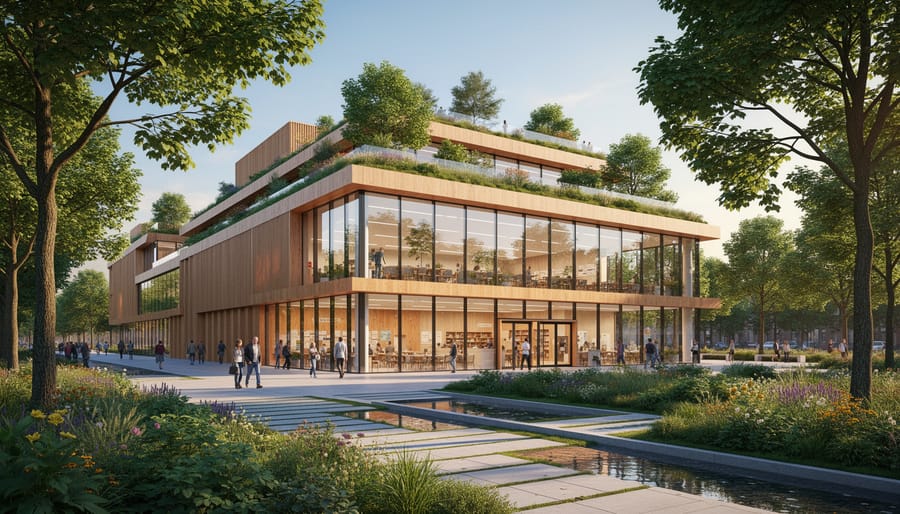
Defining the world’s most sustainable building in 2026 requires looking beyond simple certification scores to examine how a structure performs across its entire lifecycle. The question itself has become more complex as our understanding of environmental impact has deepened.
Carbon accounting now extends far beyond operational energy use. Leading buildings measure embodied carbon from material extraction and manufacturing, construction emissions, and end-of-life disposal impacts. A structure might achieve net-zero operational emissions through solar panels while carrying a massive carbon debt from concrete and steel production. True sustainability leaders address both upfront and ongoing carbon, often achieving carbon neutrality within a defined timeframe that accounts for material choices and renewable energy generation.
Circular economy principles have transformed material standards. Rather than simply specifying recycled content, the most sustainable buildings are designed for future disassembly, with mechanical fasteners replacing adhesives and modular systems enabling component recovery. Material passports document every substance in the building, creating a material bank for future use. This shift acknowledges that a building’s sustainability extends decades beyond its original purpose.
Regenerative design moves the goalpost beyond “doing less harm” to actively improving environmental conditions. Buildings now incorporate features like bioswales that clean stormwater runoff, living walls that improve urban air quality, and habitat creation that supports local ecosystems. The measure is not just minimized negative impact but quantifiable positive contribution to ecological health.
Water independence has emerged as a critical metric. The most advanced buildings capture and treat all water on-site, eliminating municipal water use through rainwater harvesting, greywater recycling, and composting toilet systems. This closed-loop approach proves particularly valuable as water scarcity intensifies globally.
No single certification captures this full spectrum. A building might earn LEED Platinum while still depending entirely on grid water and municipal sewage. Another could meet the stringent Living Building Challenge, demonstrating true regenerative performance across twenty imperatives covering energy, water, materials, health, and equity. The most meaningful assessment examines multiple dimensions simultaneously, recognizing that sustainable architecture serves both environmental and human needs.
Leading Contenders for Most Sustainable Public Building
Powerhouse Brattørkaia (Norway): Energy-Positive Public Innovation
Completed in 2019, Powerhouse Brattørkaia stands as one of the world’s most sustainable buildings by producing more than twice the energy it will consume over its 60-year lifespan, including the energy embedded in construction materials and demolition. Located on Trondheim’s waterfront, this eight-story office building generates electricity through 3,000 square meters of solar panels covering its roof and southern facade, producing roughly 500,000 kWh annually while consuming only 230,000 kWh for operations. The design tackles public buildings energy waste through extreme passive strategies: a compact building envelope with triple-glazed windows, heat recovery from ventilation systems, and seawater-sourced heating and cooling that eliminates fossil fuel dependence.
What sets Brattørkaia apart is its commitment to embodying energy reduction alongside operational efficiency. The project team calculated carbon impacts for every material choice, selecting low-carbon concrete with 70% less embodied emissions than standard mixes and FSC-certified timber framing where structurally feasible. The Edge’s smart sustainability approach similarly emphasizes holistic lifecycle thinking rather than focusing solely on operational metrics. The building’s public ground floor hosts a conference center and restaurant, democratizing access to energy-positive architecture and demonstrating that extreme efficiency doesn’t require sacrificing architectural quality or community function.
The Edge (Netherlands): Smart Building Integration at Scale
The Edge in Amsterdam, completed in 2014, demonstrates how smart efficiency upgrades and intelligent systems can achieve exceptional sustainability outcomes in a large-scale public building. Designed by PLP Architecture for Deloitte, this 40,000-square-meter office building earned a BREEAM Outstanding rating with a record-breaking 98.36% score, making it one of the world’s most sustainable buildings by measurable standards.
The building’s revolutionary approach integrates over 28,000 sensors monitoring occupancy, lighting, temperature, and air quality in real-time. Workers use a smartphone app to reserve workspaces, adjust environmental settings, and even locate colleagues, generating data that continuously optimizes building performance. LED panels with embedded ethernet connections provide both illumination and data transmission, reducing energy consumption by 70% compared to conventional office buildings while enabling granular control.
Energy performance reaches exceptional levels through rooftop solar arrays that generate more electricity than the building consumes annually, with surplus power feeding electric vehicle charging stations and stored in battery systems. South-facing atrium glazing maximizes natural light penetration while automated shading responds to sun position and temperature data. Rainwater collection supplies toilet flushing and irrigation, while aquifer thermal energy storage maintains comfortable temperatures year-round with minimal energy input. The Edge proves that integrating digital intelligence with proven sustainable design strategies creates buildings that perform better for both occupants and the environment.
Bullitt Center (USA): Living Building Challenge Pioneer
# Bullitt Center (USA): Living Building Challenge Pioneer
Completed in 2013 and certified in 2015, Seattle’s Bullitt Center became the first commercial office building to achieve full Living Building Challenge certification, the most rigorous sustainability standard in architecture. This six-story, 50,000-square-foot structure demonstrates that public-serving commercial buildings can operate as net-zero ecosystems while maintaining practical functionality for everyday use.
The building’s energy system centers on a 575-panel rooftop solar array that generates all electricity needs, backed by geothermal wells for heating and cooling. Triple-glazed windows and operable panels allow natural ventilation for 75% of the year, reducing mechanical system dependence. What sets this project apart is its 250-year design lifespan, five times the typical commercial building, achieved through exposed structural systems that simplify maintenance and FSC-certified wood framing that sequesters carbon.
Water independence proves equally ambitious. The Bullitt Center captures all water from rain, treating and reusing it on-site through a closed-loop system that includes composting toilets. This eliminated municipal water connections entirely, a breakthrough requiring special exemptions from Seattle’s building code that paved the way for future projects.
Material transparency distinguished the approach: every product underwent toxicity screening against the Living Building Challenge’s Red List, eliminating PVC, flame retardants, and other harmful chemicals. This “chemistry first” philosophy created healthier indoor environments while proving that rigorous material standards work at commercial scale. The building operates as a working laboratory, with real-time performance data publicly displayed, transforming occupants into participants in its sustainability mission.
Emerging Projects Pushing Boundaries in 2026
Several 2026 completions demonstrate how carbon-sequestering materials and regenerative design are reshaping what we consider sustainable. The Copenhagen International School’s facade uses 12,000 solar panels embedded in colored glass, generating half the building’s energy needs while functioning as a striking public art installation. In Singapore, the Khoo Teck Puat Hospital extension incorporates biochar concrete that actively removes carbon from the atmosphere during curing, achieving a 40% reduction in embodied emissions compared to conventional construction.
Mass timber towers like Milwaukee’s Ascent and framework projects in Portland showcase engineered wood’s dual benefit: sequestering carbon while replacing carbon-intensive steel and concrete. These buildings prove the world’s most sustainable building candidates now extend beyond operational efficiency to address construction’s historical carbon debt through material innovation and biological integration with urban ecosystems.
Core Sustainable Architecture Strategies from Top-Performing Buildings
Energy Systems and Net-Positive Performance
Net-positive buildings flip the traditional energy equation by producing more power than they use across their entire lifecycle. The world’s leading sustainable buildings achieve this through layered strategies that combine passive design fundamentals with advanced active systems, demonstrating that ambitious energy goals are both technically feasible and economically viable at public building scale.
Powerhouse Brattørkaia exemplifies this approach with 500,000 kWh of annual energy surplus from its integrated solar facade and rooftop arrays, enough to power ten Norwegian homes. The building’s designers stacked multiple proven strategies to cut energy waste before maximizing renewable generation:
- Ultra-high-performance building envelope (U-value 0.10 W/m²K) reducing heating demand by 75%
- Geothermal heat pumps with coefficient of performance above 4.0, extracting three times more thermal energy than electricity consumed
- Triple-glazed windows with automated shading synchronized to occupancy and solar angle
- LED lighting with daylight harvesting sensors cutting artificial lighting loads by 60%
- Battery storage systems smoothing renewable energy curves and enabling grid support during peak demand
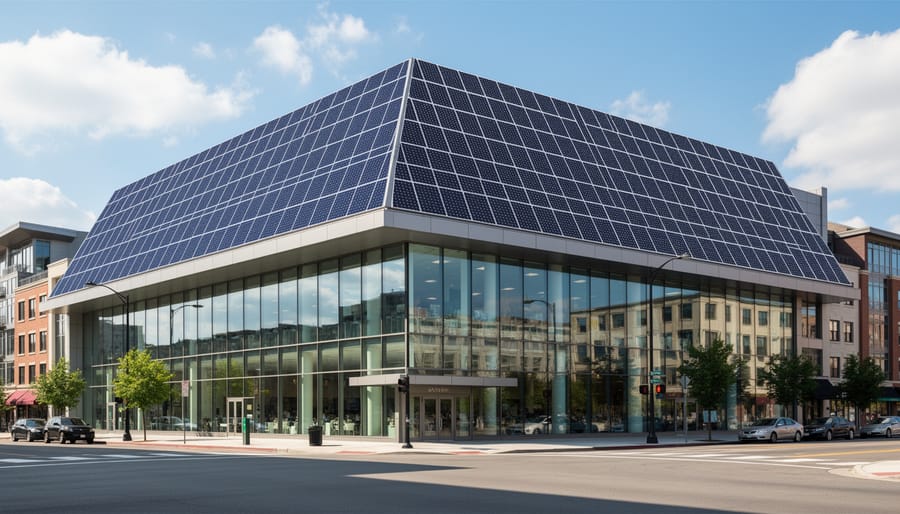
The Bullitt Center’s Seattle location presents harsher solar conditions than Norway’s latitude advantage, yet achieves energy independence through radical efficiency first. Its passive design reduces baseline energy needs to just 16 kWh per square meter annually, one-sixth of conventional office buildings, before its rooftop solar array covers the remainder. This efficiency-then-generation sequence proves more cost-effective than oversizing renewable systems to compensate for wasteful design, a lesson directly applicable to public projects facing budget constraints and diverse climate zones.
Water Management and Closed-Loop Systems
The world’s most sustainable building examples share a common approach: they treat water as a renewable resource to capture, reuse, and return to the environment. These closed-loop systems drastically reduce municipal water demand while enhancing site ecology.
Rainwater harvesting forms the foundation. The Bullitt Center captures all roof runoff in a 56,000-gallon cistern, meeting 100% of its potable water needs through filtration and UV treatment. Similarly designed systems in top-performing buildings collect precipitation for toilet flushing, irrigation, and cooling towers, cutting purchased water by 70-90% compared to conventional structures.
Greywater recycling extends these savings further. Water from sinks and showers receives biological treatment and filtration, then recirculates for non-potable uses. The Edge processes greywater through constructed wetlands integrated into its landscape, creating visible educational elements while purifying water naturally. This approach eliminates 40,000 gallons of wastewater annually per building.
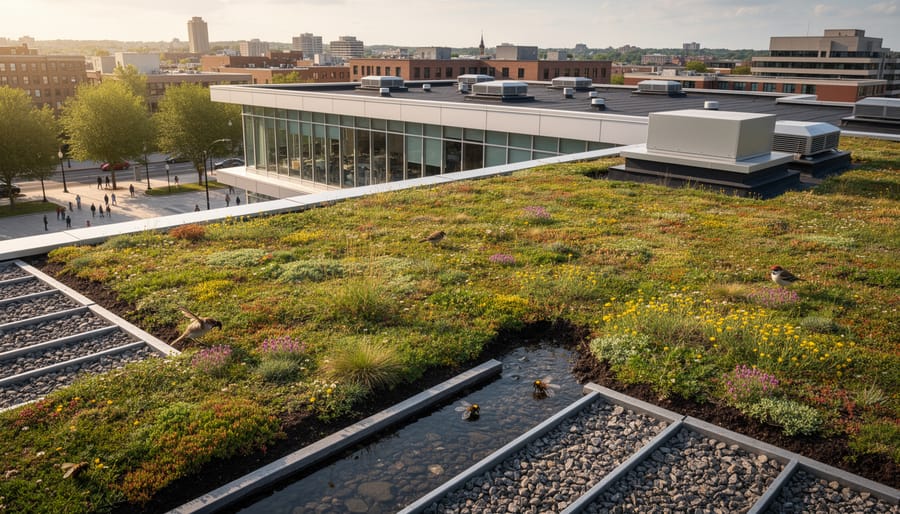
Living roofs add multiple functions: they slow stormwater runoff, filter pollutants, provide insulation, and reduce urban heat island effects. Powerhouse Brattørkaia’s extensive green roof absorbs initial rainfall, releasing it gradually to prevent overwhelming stormwater systems during heavy precipitation events.
On-site blackwater treatment, though complex, achieves true water independence. Composting toilets and advanced treatment wetlands turn waste into resources, as demonstrated by Living Building Challenge projects. These systems require careful design and maintenance protocols but prove that municipal connections are optional, not inevitable.
Material Selection and Circular Economy Principles
The buildings competing for recognition as the world’s most sustainable structure share a common thread: they’ve rethought materials from extraction to eventual reuse. Embodied carbon, the emissions locked into manufacturing, transporting, and installing building components, accounts for roughly 11% of global carbon emissions, making material choices as critical as operational energy.
Cross-laminated timber (CLT) has become a cornerstone strategy, storing carbon rather than releasing it. The Brock Commons Tallwood House in Vancouver sequestered 2,432 metric tons of carbon dioxide in its timber structure, equivalent to taking 511 cars off the road for a year. Mass timber also cuts construction time by 25% compared to concrete, reducing site emissions.
Reclaimed materials demonstrate circular thinking in practice. The Edge incorporated 95% recycled materials in its steel framework, while the Bullitt Center sourced FSC-certified wood from forests within 500 kilometers, cutting transportation emissions by 60%. These projects prove that salvaged materials don’t compromise structural integrity when properly specified.
Modular construction enables disassembly decades later. Buildings designed with mechanical fasteners rather than adhesives allow components to be removed intact and relocated. This approach treats today’s building as tomorrow’s material bank, fundamentally shifting how we calculate a structure’s lifecycle value beyond its initial occupancy.
Indoor Environmental Quality and Human Health
The world’s most sustainable buildings recognize that human health is inseparable from environmental performance. These structures prioritize indoor environmental quality through design strategies that directly impact occupant wellbeing, productivity, and long-term health outcomes.
Natural ventilation systems in leading public buildings use operable windows, stack effect chimneys, and automated louvers to maintain fresh air without mechanical systems. The Bullitt Center achieves complete natural ventilation year-round in Seattle’s climate through a central stairwell that functions as a thermal chimney, drawing stale air upward while fresh air enters through automated facade openings. This approach reduces energy consumption while delivering superior air quality compared to recirculated HVAC systems.
Daylighting strategies eliminate dependence on artificial lighting during occupied hours. High-performance buildings position workspaces within 30 feet of windows, use light shelves to bounce daylight deeper into rooms, and specify glazing with optimal visible light transmission. The Edge employs ceiling-mounted LED panels that dim automatically based on available daylight, supplementing rather than replacing natural light.
Biophilic design integrates living systems directly into architecture. Interior living walls, planted atriums, and views to exterior landscapes reduce stress and improve cognitive function. Material palettes emphasizing natural wood, stone, and earth tones reinforce psychological connections to nature.
Advanced air filtration systems in top-performing buildings maintain CO2 levels below 800 ppm and remove particulate matter to concentrations far exceeding standard building codes, creating measurably healthier indoor environments for public use.
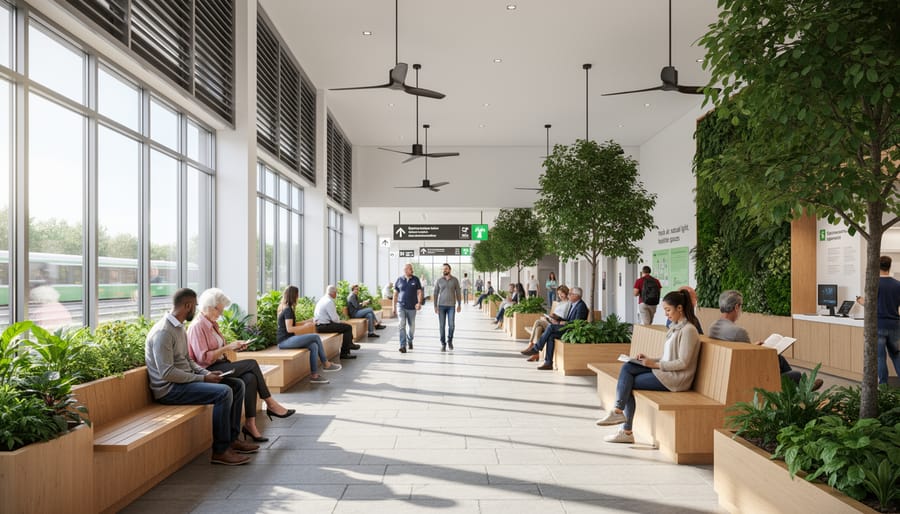
Applying These Strategies to Your Public Building Project
Translating world-class sustainability into practical public building projects requires strategic planning rather than wholesale replication. Start by conducting a sustainability audit of your project’s specific context, site characteristics, climate zone, existing infrastructure, budget constraints, and regulatory environment. This baseline assessment reveals which strategies from exemplary buildings align with your conditions and where adaptation is necessary.
Prioritize passive design strategies first, as these deliver the highest return on investment with the lowest ongoing maintenance. Orient buildings to maximize solar gain in winter and minimize it in summer. Design natural ventilation pathways that reduce mechanical cooling loads. These foundational decisions cost little or nothing during the design phase but compound benefits throughout the building’s lifetime. Many architects report that passive strategies alone can reduce energy consumption by 30-40% before adding any active systems.
Adopt a phased implementation approach when budget limitations restrict comprehensive sustainability measures. Install infrastructure for future systems even if immediate funding isn’t available, conduit for solar arrays, plumbing rough-ins for greywater systems, structural capacity for living roofs. This strategy, common in European public projects, allows buildings to evolve toward higher performance as funding becomes available without costly retrofitting.
Leverage existing certification frameworks as implementation roadmaps rather than endpoints. LEED, Living Building Challenge, and BREEAM provide tested strategies and performance benchmarks, but don’t let certification requirements dictate design decisions that don’t fit your project. Extract the strategies that address your specific challenges and save money with efficiency gains appropriate to your context.
Navigate regulatory frameworks proactively by engaging building officials early in the design process. Many innovative sustainability strategies initially face permitting obstacles simply because they’re unfamiliar to local authorities. Present precedents from other jurisdictions, offer pilot program structures, and propose performance-based compliance alternatives when prescriptive codes create barriers. Municipal planners can smooth this path by developing sustainability ordinances that explicitly permit innovative approaches demonstrated elsewhere.
The Future of Sustainable Public Architecture Beyond 2026
The trajectory of sustainable public architecture now points toward buildings that actively heal ecosystems rather than simply minimizing harm. Carbon-negative materials, already emerging in 2026, will become standard: engineered timber that locks away carbon for centuries, hempcrete that absorbs CO2 as it cures, and bio-based composites grown from mycelium. These materials transform buildings from environmental liabilities into climate solutions.
Artificial intelligence is shifting from building management to holistic design optimization. Advanced algorithms now model thousands of design permutations simultaneously, weighing solar orientation, material choices, energy systems, and occupant behavior patterns to identify configurations that maximize both environmental performance and lifecycle cost savings. This computational approach reveals synergies human designers might miss while testing scenarios that would take months manually.
Regenerative urban integration represents the most fundamental shift in thinking. Future public buildings won’t stand as isolated green showcases but as nodes in living urban ecosystems. Vertical forests that filter city air and provide habitat corridors. Green roofs that connect into continuous ecological networks across districts. Ground-floor public spaces that blur boundaries between building and park, creating shared environmental assets that serve entire neighborhoods.
Adaptive reuse will eclipse new construction as the sustainability gold standard. Converting existing structures eliminates embodied carbon from demolition and new materials while preserving cultural heritage and urban fabric. When combined with advanced retrofit technologies, historic buildings can achieve performance rivaling purpose-built sustainable structures.
The most sustainable buildings of tomorrow won’t compete for singular recognition. They’ll form interconnected systems where buildings share energy, water, and resources, functioning as organs in a healthy urban metabolism rather than isolated monuments to green design.
The search for the world’s most sustainable building reveals a fundamental truth: there is no single answer. Context matters. Climate, building type, available materials, local regulations, and community needs all shape what “most sustainable” means for any given project. Powerhouse Brattørkaia’s energy-positive performance in Norway’s climate differs vastly from strategies that work in Singapore or Phoenix. The buildings profiled here succeed because their design teams understood this principle and tailored proven strategies to their specific conditions.
Public buildings carry a responsibility beyond their own performance metrics. They educate through demonstration. When a municipal office achieves net-zero operation or a library showcases rainwater harvesting, these buildings make sustainability tangible to thousands of visitors. They shift public expectations about what buildings should deliver.
The strategies detailed here, energy-positive systems, closed-loop water management, circular material selection, optimized indoor environments, work. They’ve been tested at scale in functioning buildings. Start with these proven approaches, then adapt them to your project’s unique constraints and opportunities. Innovation shouldn’t mean reinventing fundamentals; it means applying them intelligently while pushing one or two elements further than anyone has before.
Sustainability in public architecture is not a fixed destination but a constantly advancing practice. Build better than yesterday’s best, and you contribute to tomorrow’s standard.